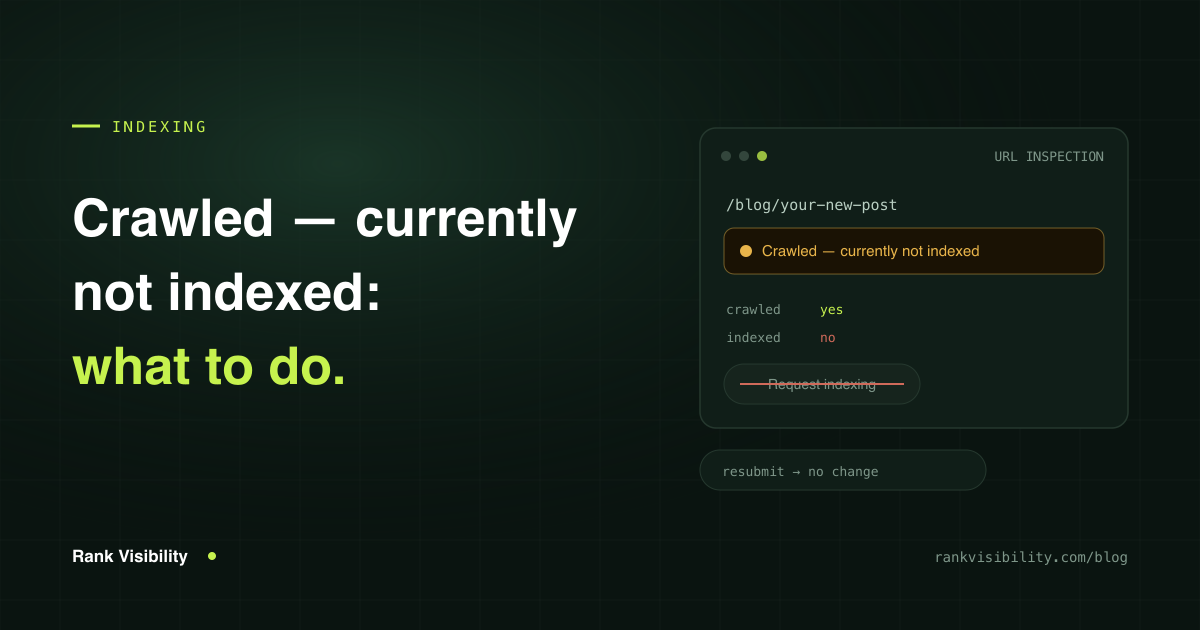
You publish a page, wait a few days, and open Search Console to find it sitting under "Crawled – currently not indexed". Nothing is broken. There is no error to fix. The page simply is not in Google, and there is no obvious reason why.
This one confuses people more than almost any other status, mostly because it looks like a technical fault and is usually treated like one. It is not. Once you understand what Google is actually telling you, the fix becomes obvious, even if it is not the fix you were hoping for.
What "crawled – currently not indexed" actually means
Google's own Page Indexing report documentation puts it plainly:
The page was crawled by Google but not indexed. It may or may not be indexed in the future; no need to resubmit this URL for crawling.
Read that carefully, because every word matters. Google found the page. Google fetched it. Google read it. And then Google decided not to put it in the index.
That makes this a judgement, not a malfunction. There is no broken tag to repair, no server error, no robots rule blocking anything. Google looked at your page and concluded it was not worth adding. Uncomfortable, but far more useful to know than chasing a technical problem that does not exist.
Crawled vs discovered – currently not indexed
These two get mixed up constantly, and treating one like the other wastes months. They are genuinely different problems.
Crawled – currently not indexed means Google fetched the page and passed on it. That is a quality and value question.
Discovered – currently not indexed is different. Google describes it as a page that "was found by Google, but not crawled yet", typically because crawling it "was expected to overload the site". Google knows the URL exists but has not got round to fetching it, often because your server is slow or the site has more URLs than Google wants to spend time on.
So: if you see discovered, look at server speed, site size, and crawl efficiency. If you see crawled, no amount of technical tuning will help, because Google already did the crawl. The problem is what it found.
Why Google leaves your pages crawled but not indexed
Google rarely tells you the specific reason, but in practice it comes down to a handful of things.
Your site is new and has no track record yet
This is the most common one, and the least discussed. Google assesses quality at the site level, not just page by page. If it is not yet convinced your site as a whole is worth trusting, it holds back on indexing a chunk of your pages, including perfectly decent ones. A new domain has no history, no established audience, and nothing to vouch for it, so Google indexes cautiously and waits.
There is no trick that skips this stage. It is a waiting period you earn your way out of.
The content is thin, or says nothing new
If a page repeats what a hundred other pages already say, Google has no reason to store another copy. Length is not the issue. A short page with a genuinely useful answer gets indexed. A 2,000-word page that circles the topic without adding anything often does not.
The honest test: does this page contain something a reader could not easily get elsewhere? Your own data, your own experience, a clearer explanation, a real example. If the answer is no, indexing is a coin flip.
AI-generated content published at scale
This has become a common cause. Publishing large volumes of unedited AI output is close to the fastest way to end up with pages that get crawled and skipped. The writing reads fine and says nothing, which is exactly the profile Google declines.
To be clear, AI in the workflow is not the problem. We use it for research and first drafts ourselves. The problem is publishing the raw output at volume with no editing, no expertise added, and no reason for the page to exist. Google is measuring whether the page is worth indexing, and unedited AI content usually is not.
Nothing links to or mentions you
Internal links tell Google which of your pages matter. A page buried with no links pointing at it looks unimportant, because structurally it is. External signals matter too. If nobody links to you, mentions you, or searches for you by name, Google has little evidence your site deserves index space.
Near-duplicate and templated pages
Location pages, service variants, and product pages built from the same template with a word or two swapped tend to collapse into this status. Google sees ten pages saying nearly the same thing and indexes one, or none.
Does resubmitting a URL to Google help?
No. This is the single most common wasted effort on this problem, and Google says so directly. Its documentation for this exact status ends with: "no need to resubmit this URL for crawling."
The reasoning is simple once you see it. Requesting indexing asks Google to crawl the page. But Google already crawled it. That is what "crawled" in the status means. Re-requesting sends it back to a queue it has already been through, to be judged against the same criteria that failed it the first time. The page has not changed, so the answer does not change.
Google's URL Inspection documentation reinforces it: "Submitting a request does not guarantee that the page will appear in the Google Index." There is also a daily quota on requests, and Google points you to a sitemap rather than manual submissions if you have many pages. Google's own search advocates have said the same thing repeatedly, that you cannot force pages into the index.
So skip all of it: the request-indexing loop, resubmitting sitemaps you have already submitted, and the paid indexing tools built on the same false premise. None of it addresses why the page was skipped.
How to fix crawled – currently not indexed
The fix is not a setting. It is making the page, and the site, worth indexing.
- Improve the page or remove it. Be honest about whether it deserves to exist. Add real substance, or merge it into a stronger page, or delete it. A smaller site of good pages gets indexed more reliably than a large one of filler.
- Link to it from pages that are already indexed. This is the most underused fix. An internal link from a page Google already trusts is a direct signal that the new page matters.
- Cut the near-duplicates. Consolidate thin variants into one strong page rather than ten weak ones.
- Build reasons to be trusted. Mentions, links, and people searching for your brand all feed the site-level judgement that decides how freely Google indexes you. This is slower than the rest, and it is what actually lifts a new site out of the waiting period.
- Publish less, better. Especially if AI is in your workflow. Volume is what triggers the problem; quality is what solves it.
If it turns out your issue really is technical, our post on technical SEO fixes that recover lost traffic covers the crawl side: 404s, redirect chains, and Core Web Vitals.
How long does it take for Google to index a page?
On an established site, usually days. On a new site with little authority, it can be weeks or months, and some pages never get indexed at all. That is not a bug.
What you should expect: as the site earns trust, the proportion of pages that get indexed rises, and it happens faster. Anyone promising a fixed timeline, or guaranteed indexing, is selling something Google does not offer.
Struggling to get your pages indexed?
If most of your pages sit in this status, the problem is usually the site as a whole rather than any single page. That is the kind of thing we untangle every day, through our SEO work and the content side that decides whether a page earns its place. Tell us about your site and we will tell you what is actually holding it back.